
The Chad-Libya War. A brief history
One of the most confusing conflicts in Africa

In the past few months, there has been a lot of political upheaval in Africa, notably in Mali, Niger, Burkina Faso, ect. So I figured now is a perfect time to revisit some lesser discussed African history.
The country I want to discuss today is Chad, one of most impoverished and underdeveloped countries in the world. It’s the 5th largest country in Africa by size, and 23rd largest by population. The bit of history I will cover is the Chad-Libya dispute which roughly lasted from 1971-1987, as well as going over some French and American activity throughout.
Let’s start with some basic history
From 1900-1960 Chad was directly under the control of the French empire, and like most French colonies, France ruled with an iron first. You can read here a full timeline of French massacres and atrocities during this period, as you can see, it’s numerous.
The French came to use Chad primarily as a source of raw cotton and untrained labor to be used in the more productive colonies to the south. Chad was an important region in French equatorial Africa as it was bordering other French colonies, notably Congo and Gabon
The French colonial administration resulted in a noticeable cultural change within Chad. France (as well as Protestant missionaries from America) spread Christianity in southern Chad as opposed to the historically Islamic (and generally Arabic speaking) north. Chad is now roughly 52-58% Sunni Muslim and 34-45% Christian.
Playing upon Religious division is often a key part of colonization, especially for the French. They did the same to Lebanon, favoring Christians against the Muslims.
France had substantially more activity and cultural influence in the south, thus leading to a regional divide between the French-speaking Christian south and the Arabic-speaking Muslim north.
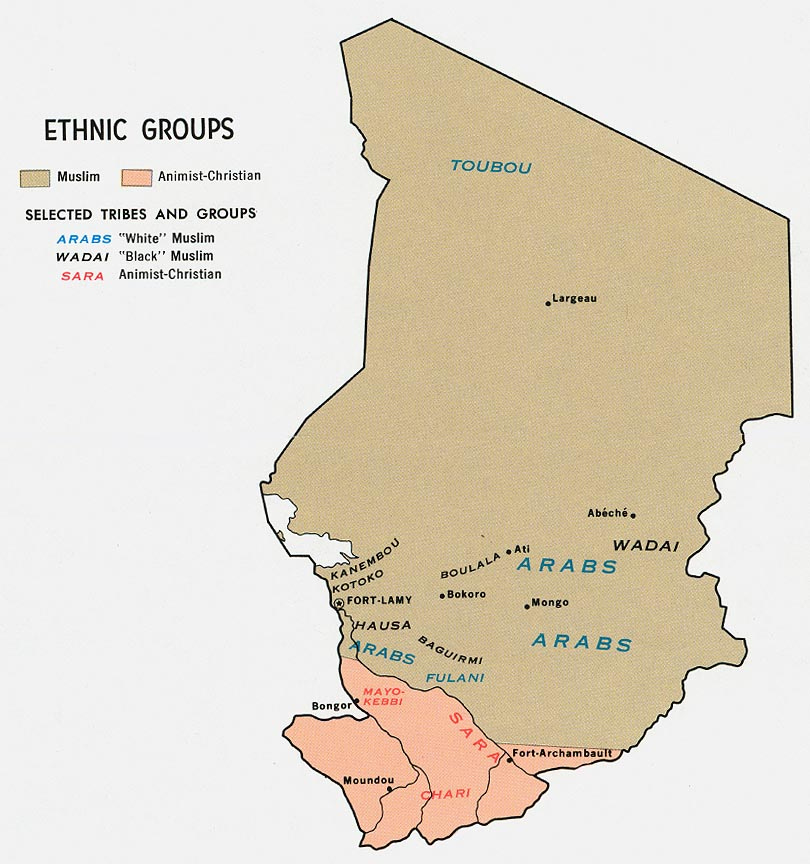
^demographic map of Chad
All of this will be important later, so let’s fast forward a bit.
After so-called “independence” one of the first leaders to come to prominence was Tombalbaye. He was your standard 3rd world neocolonial puppet who kept his country impoverished and dependent on Europe
Chad was actually one of the main countries to use the Central African franc which is one of the main ways France maintains economic dominance. I think you get the picture
Tombalbaye was obviously a brutal dictator, and early in his career went on an authoritarian crackdown to maintain political control of the country
Tombalbaye declared a ban on all political parties except the PPT (his party) in January 1962, and in April he established a presidential form of government. When serious rioting occurred in 1963 in N'Djamena and Am Timan, the government declared a state of emergency and dissolved the National Assembly.
This repression, as well as general economic decline, would naturally read to discontent.
On November 1, 1965, frustration with what was perceived as government mismanagement and tax collection abuses erupted in riots in the town of Mangalmé in Guéra Préfecture. This event is called the Mangalme riots, in which roughly 10 government officials died, and 500 civilians. This lit the fuse. Chad was quickly sprinting into civil war, and several militant groups began emerging across the north.
In 1966, FROLINAT was formed in 1966 in Nyala Sudan. Other groups and battalions particularly in the north also began to spring up. Two of the most important people during the insurgency are Goukouni and Habre (they’ll become more important later)
From Mangalmé and nearby Batha Prefecture, the rebellion spread to Ouaddaï and Salamat prefectures, where in February 1967 the prefect and deputy prefect were killed.
In August 1968, a major mutiny in Aozou among the Toubou-dominated National and Nomad Guard highlighted the continuing unrest in the north
The situation was dire. This left Tombalbaye in a vulnerable position, so he had to call onto his neocolonial handlers in France for military support
France and Chad had existing military agreements, and France was interested in maintaining influence, so they happily complied.
“Following the outbreak of rebellion in Aouzou province, President Tombalbaye requested French military intervention on August 28, 1968. The French government agreed to deploy 1,000 troops in support of the government on August 28, 1968. President Tombalbaye requested additional French military assistance in March 1969. The French government deployed an additional 2,000 troops commanded by General Michel Arnaud in support of the government of Chad (Operation Bison) beginning on April 15, 1969.”
France slowly but surely began helping the Chadian central government crush the rebellion. France even encouraged Tombalbaye to make some minor bourgeoise reforms to calm down the discontent
The French military campaign was relatively successful, but became more complicated when Libya got involved in the conflict.
Libya, in 1969, had its monarchy overthrown and replaced with the infamous Muammar Qaddafi. I assume I don’t have to introduce him much.
Qaddafi had a lot of aspirations for global revolution and anti-western resistance, especially in Africa. Chad, being directly underneath Libya, would obviously be hard to ignore.
The main issue arose in 1971. (In this section I will be quoting heavily from Arabs at war: military effectiveness 1948-1991)
“Tombalbaye's reform efforts ceased abruptly in August 1971. In that month, he claimed to have quashed a coup involving some recently amnestied Chadians who allegedly received support from Libyan leader Muammar al Qadhafi. Tombalbaye severed relations with Libya and invited anti-Qadhafi elements to establish bases in Chad. In retaliation, Qadhafi recognized FROLINAT, offered (for the first time formally) an operational base in Tripoli”
Tombalbaye accused Qaddafi of funding rebels in Chad (possibly true) so they cut relations in retaliation. Qaddafi responded by openly and substantially supporting FROLINAT. Now the war was going hard again.
Another reason why Libya was interested in Chad was the Aouzou strip. This was a disputed region for Libya, going back to the original drawing of the colonial borders. The strip was also rich in uranium which was also very interesting for Libya. Needless to say they had a lot of incentive to be in that region
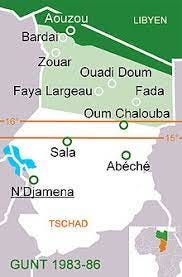
France was still involved though, and doing a lot of heavy lifting to support FROLINAT during this period. But they would eventually become ineffective
“French troops clashed with FROLINAT rebels near the Sudanese border on February 18, 1972, resulting in the deaths of 45 rebels and three French soldiers. French government troops completed their withdrawal from Chad on August 28, 1972.”
That was the end of Operation Bison, but the French still had a low level activity in the country. In fact, they had almost 600 military advisors in the country despite apparently withdrawing.
Either way, Tombalbaye was in a worse position than alternatives to stay afloat. Being a Christian, he did not have much support in the neighboring Arab World, so he decided to cut ties with Israel to try and mend the situation and improve his relations. this did apparently work to some extent
“it is likely that Chad’s break with Israel resulted from a long campaign of pressure by Libya rather than from a one-time handout from Saudi Arabia. Qaddafi has been supported by the rebel underground movement in Chad against the Christian Tombalbaye. Until recently the President could count on French support to bolster his regime: but in February the French pulled their troops out, apparently unwilling to appear to support a regime which was the obvious target of Qaddafi’s hostility.
Tombalbaye (being a Christian) saw the situation was awful, and decided to cut ties with Israel and gain more support from the Arab world. Libya accepted this
“By 1971 Chad had lost control of the Aouzou Strip.8 Libya began occupying the area in the first half of 1973. It was then rumored that Colonel Kadhafy and Chadian President Tombalbaye had signed a secret agreement in 1972 whereby Chad ceded the Aouzou Strip to Libya in exchange for twenty-eight million francs and Libya's guarantee that it would stop funding FROLINAT.”
Qaddafi would move in his forces in 1973, beginning his 14 year long occupation of the Aouzou strip in Northern Chad. This would become a major force of contention for years to come
So Tombalbaye made peace with Libya, making concessions on Aouzou-strip, in order for financial aid and eventual peace with FROLINAT. His position though, was not saved. The fighting continued and his lack of effectiveness proved fatal. The killing blow was in part due to his horrible mismanagement of a famine.
Finally, on April 13, 1975. Tomabalbye was Coup’d
The people who took his position were Noel Odingar and Felix Malloum.
Noel Odingar was a general in the existing Chadian army. Malloum was a former soldier in the French army, but was arrested by Tombalbaye on suspect charges of conspiracy in July 1973. General Odingar didn’t particularly like Tombalbaye because he was simply incompetent and was messing up the war. They were also largely authoritarian through
“General Odingar suspended the constitution, dissolved the parliament, and banned political parties on April 14, 1975. General Felix Malloum was appointed chairman of the nine-member Supreme Military Council (SMC) on April 15, 1975. The Libyan government provided diplomatic assistance (diplomatic recognition) to the SMC on April 18, 1975. General Malloum formed a provisional government as head-of-state and prime minister on May 12, 1975.”
The new government demanded the withdrawal of French military advisors from the country on September 28, 1975, and French military advisors were withdrawn on October 27, 1975
So France was (temporarily) out of the picture, but the war was still raging. The situation was highly unstable.
You know how I mentioned Goukouni and Habre would be important later? Well they were key figures in FROLINAT and ended up splitting in 1975.
To put the division simply, Habre was more Pro-Libya and Goukouni was more Pro-Libya. Although Goukouni didn’t necessarily love Libya, but just saw it as more convenient partner for the time being
Habre joins the Malloum government. There was a brief period in which Goukouni and Habre tried to reconcile, but ultimately it didn’t work. (There is a lot of switching sides in this conflict)
By 1978, they were back at fighting, and Goukouni was working directly with Libya
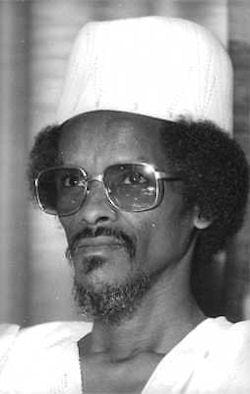
^Goukouni Oueddei
“In February an army of 2,500 Frolinat fighters, with possibly as many as 4.000 Libyans providing fire support, attacked the key town of Faya Largeau in north-central Chad”
This offensive was not particularly successful though. Habre continued to have the upper-hand.
It’s important to mention that he was getting strongly backed by both France and the USA.
By 1979, Goukouni also began to question his position. And warmed up to the central government once again
“Goukouni hurried south with his Second Liberation Army to contest power. Rather than fight a mutually destructive battle in the capital, the two 'Toubou armies (along with the remnants of the national army led by former Chadian army colonel Wadal Kamougue) were able to strike a deal based, to a considerable extent, on a common desire to see Libva out of Chad. The result was a new government of national unity known as the Government d'Union Nationale de Transition (GUNT).”
This was obviously a big blow to Libya, Goukouni was their major ally. Qaddafi was not happy with this and responded with a full ground invasion of his own
“The Libyans were incensed that the new gunt did not include any of the leaders of the Volcan Army nor recognize Libyan claims on the Aouzou Strip. Qadhafi reacted by ordering a Libyan invasion of north-central Chad in November 1979 to compel the new government to recognize his influence in northern Chad. He sent a force of several thousand Libyan troops with armor and air support along with elements of the Volcan Army to retake Faya Largeau. This time, however, the Libyans were opposed by Goukouni's forces.”
This was obviously a bad situation for Libya, and it would continue to get even more confusing (and dumber)
After the Libyans were ousted, Habré chafed in his position in the new government under Goukouni, and on 16 March 1980, he expelled the GUNT from N°djamena. Habre and his forces, now called the Forces Armée du Nord (FAN), then set out to gain control of the rest of the country.
The FAN was rebuffed by Goukouni's GUNT at Bokaro and Mongo, north of the capital, but regrouped and was able to drive the GUNT out of north-central Chad. Then on 1 April, Habre's FAN smashed Colonel Kamougue's army at the Chari River south of N°djamena, destroying Goukouni's only real ally. With Kamougue's forces eliminated and the ran victorious everywhere, Goukouni was forced to turn once more to Tripoli for aid.
Yeah you read that right. Let’s give a recap so far, Goukouni and Habre used to work together in FROLINAT, then they split, tried to get back together, Habre joined the government, Goukouni sided with Libya, and then Goukouni ended up ditching Libya to work with Habre again, and then got betrayed and went back to Libya for support. Confused yet? It only gets worse.
Libya was glad to have Goukouni back as an ally, but understood it was only opportunistically. Libya ultimately did not have any consistent ally in this conflict
“The GUNT forces regrouped in southern Libya, where they rested and were re-equipped by the Libyans. Indeed, at that point Goukouni even accepted a Libyan officer, Mansur Abd al-Aziz, as commander of the GUNT forces. Starting in August 1980, Tripoli also mustered an army of Libyan regulars and Islamic Legionnaires at Sabha in southern Libya Then, in October 1980, before Habré had had the opportunity to consolidate his rule, the Libyans, the Volcans, and the GUNT invaded Chad. Qadhafi sent 7,000 Libyan regulars with 300 T-55s and several batteries of BM-21s, all backed by much of the Libyan Air Force (LAF), along with 7,000 members of the Islamic Legion into Chad.”
The Libyans were not necessarily good fighters but had a much stronger military advantage due to Soviet tech and more oil money. So by pure firepower they made a lot of success. They were headed straight to the capital.
“N'djamena fell to the Libyans and the GUNT on 15 December.
Qadhafi had finally achieved his goals: N°djamena and the government were in the hands of Goukouni, who was not only beholden to Qadhafi for helping him retake the country but also effectively hostage to the nearly 15,000 Libyan soldiers deployed across Chad. What's more, the Libyan offensive had been a stunning accomplishment, if only as a logistical operation”
Qaddafi was getting too comfortable though, and forgot he was dealing with nationalists. Goukouni saw Libya as a useful tool, but didn’t necessarily want him occupying the country. Soon he started pressuring Libya to leave. Understanding that he overplayed his hand, Qaddafi agreed.
Goukouni's rule over Chad did not last long. While the Libyans licked their wounds in the Aouzou Strip, Habre and the Fan retreated to Sudan, where they regrouped, retrained, and recruited new soldiers. With covert aid from Sudan, Egypt, France, the United States, and a number of other countries that all opposed Libya for one reason or another, Habré was able to rebuild the RAN into an efficient fighting force by early 1982. In May of that year, his forces invaded Chad from Sudan.
Two days later, on 7 June 1982, Habré reentered N°djamena and proclaimed himself president of Chad. Habre was once again in power.
It should be once again noted that Habre was receiving massive support from France and America. The USA was very hawkish on Libya (a Soviet ally) and the CIA noted it would be beneficial for them in the region
“To the extent that Western prestige suffers, that France and the US quarrel, or that Western commitments to African and Arab clients are weakened, it will be advantageous to the USSR. And if the result of the Libyan intervention in Chad is to radicalize other regimes in the area, that too will be a plus for Moscow”
So given this, they really wanted Habre to win against Libya. It was essentially a proxy war against a Cold War rival.
Per the Washington post
“The aid to Habre was the first clandestine operation launched by Reagan's CIA chief, William J. Casey, when he took over the agency in 1981. The covert aid, channeled through Sudan and Egypt, eventually totaled hundreds of millions of dollars, the U.S. officials said.
After Habre seized power, he immediately set up the DDS with French and U.S. help, according to published accounts and U.S. sources. Its officers quickly established a reputation for brutality, but still received U.S. training in intelligence analysis. Habre's intelligence units and the CIA shared information extensively, according to three former senior U.S. officials familiar with events at the time.”
Hissen Habre was a brutal dictator, and he was receiving strong support from France and the CIA this entire time. It would be hard to summarize all the horrible stuff he did, so I will link this HRW page which gives a good overview. He was a favored puppet of the Reagan administration
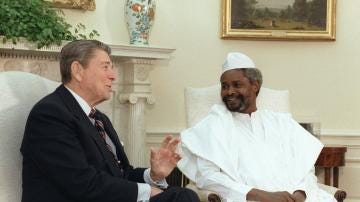
^Hissène Habré and Ronald Reagan meeting in 1987
Due to the general lack of manpower, Habre needed backup. The western-backed dictator of Zaire (Mobutu) was there to help as well. As you can imagine, Habre had an alliance with all the other Neocolonial puppets in the region.
“'I have come to show that Chad does not stand alone,'' said President Mobutu, who has sent more than 2,000 troops to support the Chadian Government in its battle against Libyan-backed insurgent”
Libya was interested in this situation though, and saw it as an opportunity to get involved again. Qaddafi really wanted to hold his ground in Chad
“Libya once again welcomed Goukouni and his GUNT fighters, providing them sanctuary, arms, and assistance. Qadhafi also began to prepare to intervene once again in Chad in the near future, renegotiating an alliance with Goukouni and building up Libyan forces in the Aouzou Strip. In 1983 Qadhafi believed his forces ready and again invaded Chad along with the GUNT and Volcan armies.”
Yeah, after all of that, Qaddafi still accepted Goukouni again. Despite the initial betrayal (As I said, there is a lot of switching sides in this war)
So in August 1983 Qadhafi ordered another general Libyan invasion of Chad, with the regrouped GUNT leading the way. 3rd times the charm I suppose?
“This time the Libyans committed 11,000 troops, most of them regulars, to the operation and airlifted virtually the entire force - complete with tanks and artillery - directly into the Aouzou Strip. Although Tripoli again dispatched large numbers of tanks and APCs as well as roughly eighty combat aircraft (a considerable portion of the operational L.AF) for the offensive, Libyan forces still played their traditional role of providing fire support (and the occasional headlong tank charge) for GUNT assaults. The GUNT probably contributed 3,000-4,000 men to the invasion force.”
The fighting was pretty brutal, with casualties on both sides. France was involved a bit, but mostly stayed out of it. Libya fought especially hard for the Aouzou strip (essentially his whole reason for the war). They did this pretty successfully and maintained the strip.
In addition, the Libyans had had a chance to regroup, resupply, and establish positions in familiar territory. As a result of these factors, Habré's offensive quickly came to a halt in a few small battles. The Aouzou strip remained with Libya. This finally led to a negotiation on peace
“In April 1984, with the war in Chad having bogged down into stalemate, the French proposed a mutual withdrawal to the Libyans. Tripoli accepted, and in September an accord was struck in which both sides pledged to pull all of their forces out of the country immediately. Although the FaNt protested vehemently and warned Paris that the Libyans would not abide by the agreement, French president François Miterrand was adamant, and his troops were out of Chad by November. The Libyans did pull out some forces, but they kept roughly 6,000 troops camouflaged in the north.”
Habre did not have much ability to contest this, the French didn’t support him. Libya seemed to be victorious. But it was far from over
America was aware of the situation, and did not want Libya to win. So by the mid 1980s they continued to ramp up support.
Throughout the early 1980s, the Reagan administration had grown increasingly bellicose toward Libya and increasingly willing to support Habré's FANT as Libya's enemy. In 1985 the United States increased its aid to the FANT, providing arms, money, intelligence, supplies, and diplomatic support. The United States and France (in large part thanks to U.S. pres-sure) provided the FANT with more-powerful weaponry, increased training, and extensive logistical support
This new equipment and support gave Chad a real opportunity to stand up against Libya. One of the biggest aspects was getting direct logistical support and training from French soldiers
“By 1986, Habré had a corps of aggressive, flexible, seasoned commanders such as Idris Deby, Ahmed Gorou, Muhammad Nouri, and Hassan Djamous commanding FANT forces in the field, which enabled him to spend his time overseeing the larger conduct of the campaign and attending to logistical, diplomatic, and administrative matters.”
By 1986, FANT was making advances. Qaddafi was completely surprised. He tried to poke back, and went for the largest offensive in the past two years of fighting
“At the beginning of February 1986, the Libyans and the GUNT attacked south from their positions in north-central Chad. This offensive was far larger and more ambitious than Libyan-GUNT operations over the past two years and may well have been another bid to conquer the entire country.”
This did not end well at all for Libya. They were frankly getting demolished. And ended up in a worse position
“On 13 February the FANT counterattacked, retaking Oum Chalouba and Kalait the next day and crushing the Libyans and the gunt with their new weapons and tactics.
The Libyans were beaten so badly that they were forced to pull back to the Aouzou Strip to regroup and were unable to resume the offensive until March. By then, Habré had concentrated considerable forces in the Oum Chalouba area, and the Libyans were repulsed with heavy losses.”
At around this time Qaddafi and Goukouni had a falling out (again). The GUNT went to join Habre (again) and now Libya was fighting everyone (again). As I said, switching sides happens a lot during this war
“In early December 1986 the Libyans sent a brigade task force of 2,000 men with T-62 tanks and heavy air support to smash the GUNT and retake the Tibesti. Because of this firepower, to which the GUNT had no answer, the Libyans were able to force its former allies out of Bardai, Wour, and Zouar once again. However, Habré recognized this moment as his opportunity to unite all of Chad behind him and drive the Libyans from the country. He sent 2,000 FANT troops to the Tibesti to link up with Goukouni's forces. The infusion of these newly equipped and trained troops allowed the Chadians to stop the Libyan advance,”
This whole section of the war was called the “Toyota war” because the Chadian side was effectively using Toyotas in combat. This began the downfall
“The Toyota War is the name given to the last phase of the Chad-Libyan War that raged on for almost a decade, yet did not have relevance until its last phase. This last phase began in 1986 and ended a year later with a heavy defeat inflicted on the Libyan army by the Chadians. In total, 7,500 men were killed and 1.5 billion dollars worth of military equipment was destroyed or captured. Conversely, Chad only lost 1,000 men and very little military equipment (because they hardly had any).
The last phase of the conflict developed in the disputed area of the North of Chad, an area that had been occupied by Libyan forces in 1986 due to its natural resources such as uranium (highly interesting for Gadhafi and his nuclear armament project). At the beginning of 1987, the last year of the war, the Libyan expeditionary force comprised 8,000 soldiers, 300 T-55 battle tanks, multiple rocket launchers and regular artillery, as well as Mi-24 helicopters and sixty combat aircrafts. However, the Libyan soldiers were demotivated and disorganized. The Chadians, on the other hand, had nothing but 10,000 brave and motivated soldiers with neither air support nor armored tanks. However, by 1987, Chad could count on the French Air Force to keep Libyan aircraft grounded but, perhaps more importantly, a 400 Toyota pickups fleet equipped with MILAN (Missile d'infanterie léger antichar) anti-tank guided missiles sent by the French Government.``
The Chadian forces (With help from France and Toyota) were able to slowly move up north and began squeezing out the Libyans. It was not particularly close. Libya took much worse losses.
“Over the entire course of the 1987 campaign, the Libyans suffered at least 7.500 dead and nearly 1,000 captured soldiers in addition to losing nearly S1.5 billion worth of equipment, including twenty-eight aircraft and over 800 tanks and Apes. In all of these battles combined, the Libyans killed fewer than 1,000 FANT soldiers.”
So, that is basically the Libya-Chad war. It is a lot more confusing then this, but I tried to give a solid overview
What is the moral of the story?
Well I’m not really sure. This war was pretty bad for both sides. Chad had it’s entire economy, stability, ect disrupted for a 10+ year long war. Libya also took heavy casualties and did not particularly gain much. The main winner was France and America who got to install a new Neocolonial puppet that would help them out against a geopolitical rival. So, 3rd world countries probably shouldn’t be fighting each other in pointless wars that only help the imperialists?